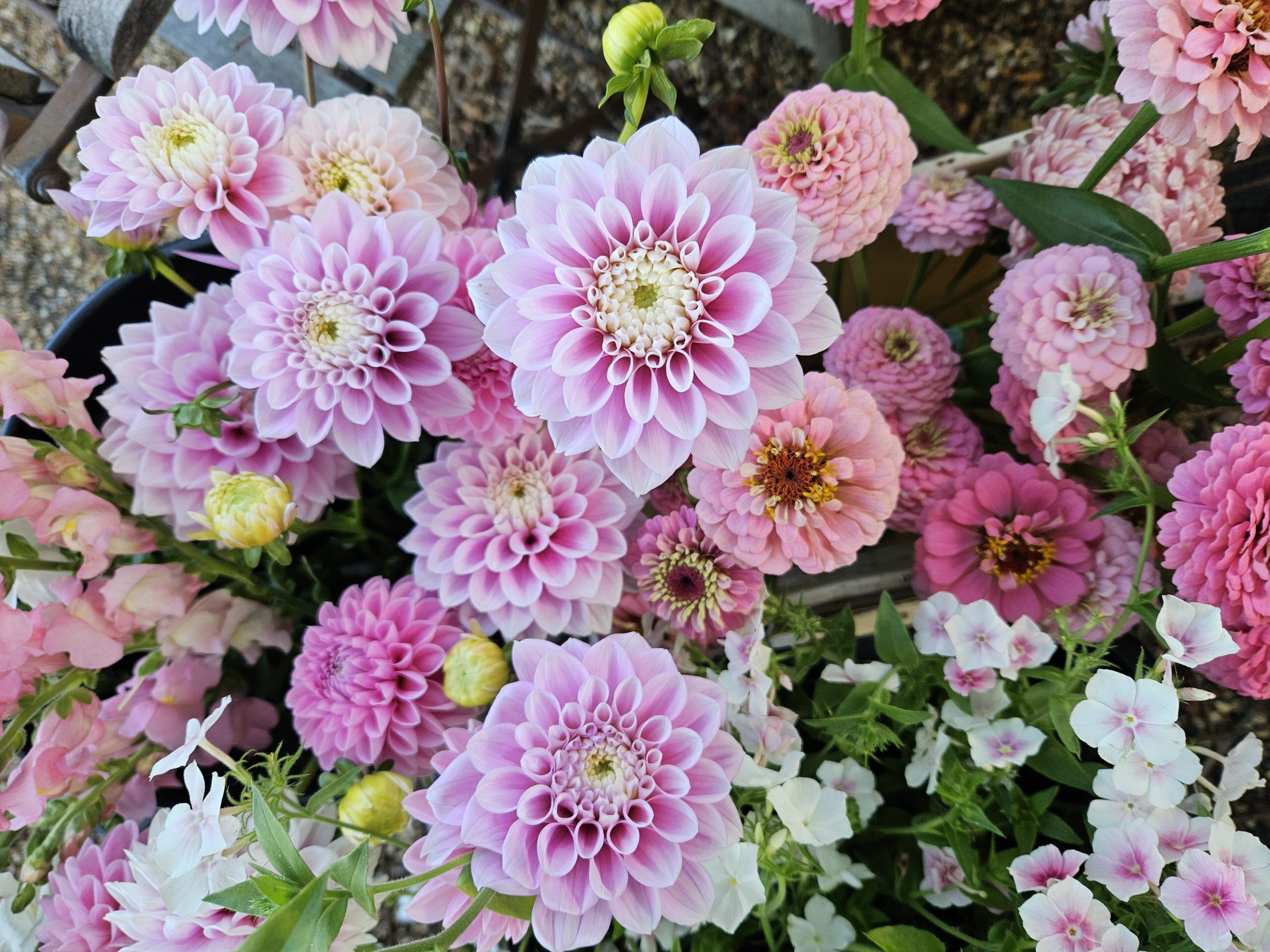
Creating your own floral displays for your wedding can be tremendously exciting. That said, I’ve worked with many couples over the years who start out full of enthusiasm, only to feel a little daunted as the big day approaches. My hope is that this guide reassures you, helps you plan with confidence, and allows you to create beautiful, stress-free flowers you’ll feel hugely proud of on your wedding day.
How Many Flowers Will I Need?
This is by far the most common question I’m asked — and also the hardest to answer. When you work with a wedding florist who offers a full wedding service, stem counts are something calculated for you. While it does become intuitive with experience, it still takes time and careful consideration and it is included in the prices we charge for our full wedding service.
With a DIY option you need to work these out yourself, and this can feel daunting. As an average, a bridal bouquet takes 30-50 stems and a bridesmaids about 25. Bud vases take between 2 and 5 stems. However, there are several key factors to bear in mind:
Time of year
If you’re using seasonal flowers, stem size will vary dramatically. Spring flowers like tulips tend to have larger heads, while summer blooms such as cornflowers are naturally smaller, and autumn brings bold dahlias. This directly affects how full your arrangements will look and how much space they take up in a vase.
The overall look you’re aiming for
Do you want abundant, bouncy arrangements overflowing with flowers, or something lighter and more delicate with thoughtfully placed stems? A floriferous style will require far more stems than a minimal one. For planning purposes, assume one stem in your bucket equals one flower. While some stems may have side shoots you can snip off and use elsewhere, it’s best not to rely on this when calculating numbers.
Our DIY buckets are for table displays, bouquets and buttonholes only. For larger dislays like milk churns and urns you will need different ingredients and longer stems, so please chat with me before ordering and we can provide you with the best types of stems for your needs.
Your vessels and vases
Bud vases require very few stems, while larger vases for signing tables or entrances will need significantly more. Vase size and shape play a huge role in stem count.
If all of this feels a bit overwhelming, my advice would be twofold:
- Buy or forage some flowers in advance and practise making your arrangements, then physically count how many stems you use. This really is a great way to build your confidence, so when the big day comes you are prepared.
- Or book a one-hour one-to-one session with me. We’ll work through some of your displays together, create mock-ups of using flowers from the field, and calculate exactly what you’ll need. You’re very welcome to bring a friend along too — just drop me an email for details.
Planning and Creating Your Displays
Once you have picked up your actual flowers, a little organisation goes a long way.
- Keep your flowers somewhere cool after collection and top up buckets with fresh water. Use sharp snips or secateurs and trim stems to size as you work.
- Start with your most important arrangements first. Bridal bouquets should always come before anything else, followed by entrance displays, then table arrangements, and finally smaller vases such as the signing table. Any leftovers can be dotted around the bar or even in the loos — they’re always appreciated.
- Work in odd numbers. Groups of three or five stems look far more natural than twos or fours.
- Be mindful not to over-stuff. If you’ve planned 20 table arrangements at 20 stems each, adding “just a few more” quickly leaves you short. Five extra stems per vase equals 100 stems you didn’t plan for.
- Avoid very tall vases on tables. As a rule of thumb, your arrangement should be around 1.5 times the height of the vase. Low bowls or bud vases are far more practical and allow guests to see one another across the table.
When deciding how many arrangements to use, remember that wedding tables fill up quickly with crockery, candles, wine and sharing platters. Bud vases or low bowls dotted along the table are often more practical than one large centrepiece. Pinterest can be a great source of inspiration — just make sure the look you love fits comfortably within your budget. There’s no right or wrong choice.
Making Your Flowers Work Harder
Think about how arrangements can be reused throughout the day.
- Displays used outside the church can often be moved to the reception venue afterwards.
- Meadow boxes along aisles are more versatile than pew ends — they can be transported by car and later placed along the top table or around the venue.
- If there are shady spots or umbrellas above outdoor tables, you can move your table displays outdoors. Always keep them out of direct sunlight, especially if it’s a hot day.
Sustainability Matters
Please avoid using floral foam. It’s toxic to handle and extremely damaging to the environment. None of our flowers have been tested in foam-based arrangements. Chicken wire and moss are far more sustainable alternatives, and if you book a one-to-one with me, I’ll happily show you how easy they are to use.
Practical Tips for the Big Day
- Leave twine and snips at your venue and ask a willing helper to bundle up flowers after the wedding. Guests love taking home a keepsake, your flowers last longer, and it means less clearing up for you — a win-win.
- Don’t panic if a flower droops after transport. Some varieties sulk briefly. Re-cut the stem at a 45-degree angle, place it in deep cold water, and give it 30 minutes to recover before arranging.
- Order around 10% more flowers than you think you’ll need. Breakages and over-enthusiastic hands are almost inevitable.
- If time is a concern, you can collect your flowers the morning of the day before your wedding. For a Saturday wedding, I recommend Friday morning collection and arranging everything on Friday. Your flowers will be freshly picked and will last well. More details can be found in my downloadable advice sheet on my website.
Assemble Your Flower Team
Choose your helpers wisely and allocate clear roles — for example, Auntie Kate on the signing table flowers, bridesmaids on table decorations, and the best man on buttonholes. Give each person only the flowers they need to use, remind everyone to keep spare stems in water, and have one helper dedicated to clearing up as you go.
Bring plenty of buckets, a dustpan and brush, a small broom, and tubs for green waste. Many venues have compost heaps, so it’s always worth asking.
With a little planning, the right support, and realistic expectations, creating your own wedding flowers can be a truly joyful part of your celebration.
Leave a Reply